

On the Humpback Highway: My Whale Season as a "MIMtern" in Geographe Bay - From BREACHES to BLUE WHALES!

Updated: May 17
Author: Lucy Whelan
A MIM Intern's (MIMTERN) Experience on the Water
I absolutely loved being a MIMtern in Geographe Bay during the 2025 whale season! We had some super exciting days out on the boat collecting data for Western Whale Research and the South West Whale Research Collective, helping to support collaborations with ongoing marine mammal research in the South West of Western Australia (WA).

The Importance of Long Term Whale Monitoring
The dataset stretches back over 35 years which helps to better understand the annual population of humpback whales (and other species) migrating along the coast of WA. This coast is a vital migration path for humpback whales travelling from their polar feeding grounds in the Antarctic to their tropical breeding grounds up in the Ningaloo region and Camden Sound, Broome. Globally, this is the largest known humpback whale breeding and calving ground. Decades of consistent data collection allow researchers to track changes in population size, migration timing, behaviour, and environmental influences.
During the season, we recorded detailed information including:
Interaction time
Pod size and composition
Sighting cues and GPS waypoint locations
Direction and speed of travel
Environmental conditions such as weather and swell
Behavioural observations including breaching and spy hopping
All of these factors are crucial to be able to get the most accurate data and current understanding of the whale population.
First Days on the Water
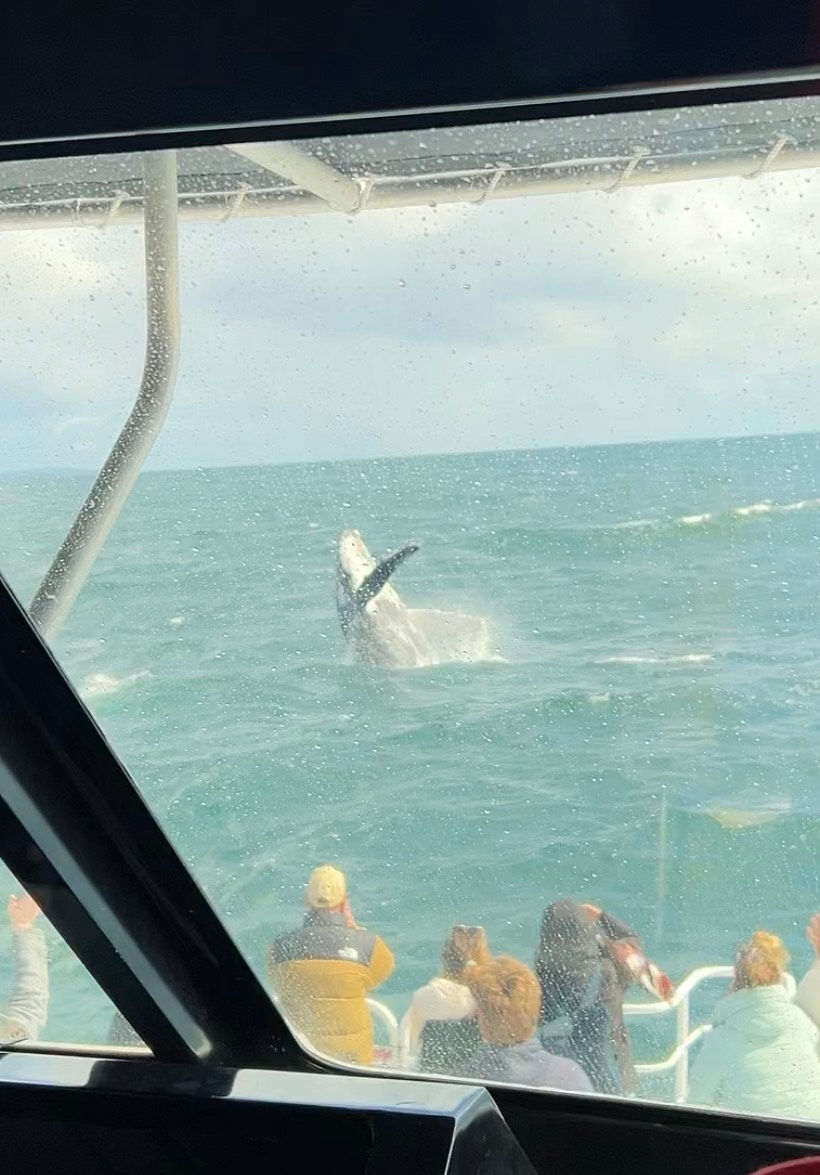
On my first day in mid-August, I was very excited to be on the boat ‘Whale Song’ with All Sea Charters to start the season off and learn all about the data collection process on board (Image 1). Our first tour of the day truly set the standard for the rest of the migration period with a Humpback breaching right at the bow of the boat (Image 2). Individuals were also seen to be spy hopping (Image 3), displaying their curiosity for our boat while in the company of Bottlenose Dolphins.

During my first two days, a southern right whale and her calf were resting in the shallows of the bay (Image 4). It was a beautiful opportunity to observe the pair together, keeping our legal distance of +300m. Even from afar, we were able to appreciate the calf’s playful movements and the mother’s attentive, maternal nature.

Developing My Skills as a Whale Observer
At the start of the season, it can be harder to identify the cues for humpback whales. The initial cues to watch out for are a subtle footprint on the surface of the water or a more evident breach. If your eyes are not on the water at all times, it can be very easy to miss the cue. As this was my first year as an intern with MIM Network and having had no previous professional experience observing humpback whales, I feel that my skills in spotting individuals progressed significantly within those few months (Image 4). This was not only with humpback whales, but with other species alike and I found I was able to identify them more promptly during this time.
The Humpback Highway Comes Alive
As the season progressed, the humpback highway became a hive of activity for us to record our data. There was an abundance of breaches, spy hops and tail/peduncle slaps each day, which created great opportunities for some perfect photo-ID shots that were later uploaded to Happywhale for further analysis (Image 5). Some days were so active that if you were to look out towards the horizon, there would be a continual repetition of breaches from one whale to the next. This behaviour is commonly used as a form of communication between nearby individuals, setting off a chain reaction of conversation. I also encountered several humpback whales displaying peduncle slaps, which are also predominantly used for communication purposes. These behaviours confirmed that there were more humpback whales in the area than we were able to see.

A Rare Encounter: Dwarf Minke Whales
We had a very unique experience on the 23rd August 2025 with dwarf minke whales visiting Geographe Bay. The pod of five interacted with the boat for approximately 20 minutes, which was incredibly exciting for everyone on board. The whales stayed within proximity to one another while showing signs of being intrigued by "Whale Song". Rolling behaviours were displayed, giving us the opportunity to observe their distinct markings and colouration specific to this species.
Emily Evans (co-founder of MIM Network) was especially excited by this encounter, as it contributes to her research on understanding more about the little-known dwarf minke whales off our WA coast. To experience this and collect this data was really special! Dwarf minke whales have been observed in this region over the years but are difficult to collect visual data on - attached here are some images of this really fun encounter (Image 6-7).


An Unforgettable Blue Whale Sighting
During late September, we exited Port Geographe Marina and I sighted a blow from behind us and notified the captain straight away. Due to being in such shallow waters, we were unsure if it may have been a Bottlenose dolphin or, at a far stretch, a humpback. It was soon discovered that it was actually a BLUE WHALE, the very first of the season! (Image 8). It was resting in 5m depth water which was INCREDIBLE and very rare! It surfaced twice, displaying the sheer size of its body length. Dr. Grace Russell, the founder of the Fat Whales Project, was onboard at the time and was ecstatic at the early morning find. She was able to capture an ID photo of its dorsal fin that she hopefully was able to use in her research which focuses on the body condition of Blue and Humpback whales. This was my first Blue Whale sighting and it is one I will truly never forget!
Later that day, thanks to social media, we discovered the same blue whale was sighted not long after we left it, at the iconic Busselton Jetty. It was later recorded again in Dunsborough by local citizen scientists operating from the land-based monitoring station. The earlier dorsal ID shots collected by Dr Grace Russell later confirmed that all sightings were of the same individual.
The whale was named “Berry” the blue whale. The sighting quickly gained attention due to its rarity and very unusual and shallow presence. (Watch the blue whale at the Busselton Jetty)

Looking Ahead to the 2026 Season
I am really looking forward to the 2026 whale season and all it has to offer. The MIM Network team were very supportive throughout and were always there to answer any questions, no matter how big or small. On the boat, I was consistently learning new things which made no two days the same. Being surrounded by a wealth of knowledge from all of the staff onboard and other MIMterns was an amazing way to expand my network and own knowledge.
Reflections on the Experience

Meeting like- minded people with similar interests and hobbies only further developed my passion for marine conservation and the importance of the research that is carried out here in the South West of WA. I’m very grateful to have had this experience and to be a part of this valuable data collection process for these amazing species. I can’t thank the MIM Network enough!
All images taken under scientific research permit by Lucy Whelan.


Comments